
Software Updates: From Changelogs to Agentic AI
Software Update Questions and Answers
Research Seminar · September 24, 2026 · Berhe Lab, University of the Pacific
An answer pipeline
Software Release Patterns:
when is it a good time to update a component?
S. Berhe, M. Maynard, F. Khomh · Procedia Computer Science 170:618–625 · EDI40 2020, Warsaw
Rewriter: from “more stable?” to “recent major updates?”
Retriever: changelogs, from human to static bots
Evaluator: aggregate risk, from any time to a stable time
Latest Zoom update, from Zoom’s public changelog page (Source: Zoom changelog)
Method
Data: 3,742 components, 8,537 changelogs, Jan 2018 to Jul 2019
Retriever Bots
- GitHub: tag = version, commits
- NIST NVD: CVE advisories
- Vendor changelog page
Evaluator
- Aggregate, not one component
- By date: day to quarter
- By type: beta, major, CVE
Result
In the yearly aggregate, the most coinciding updates fall in mid-January and mid-week.
What went well
- Clear weekly and yearly peaks
- Open: GitHub, NVD, vendor page
- Turns into update advice
Limitations
- No user reports
- Commits replace changelogs
- Only semantic version numbers
- Static, hard-coded questions
- No dependencies evaluated
Maintenance Cost of Software Ecosystem Updates
S. Berhe, M. Maynard, F. Khomh · Procedia Computer Science 220:608–615 · EDI40 2023, Leuven
Rewriter: from “Zoom or Teams?” to “Zoom or Teams with Chrome, Safari, or Firefox Stack?”
Retriever: from a list to a graph
Evaluator: from release timing to ecosystem cost
Model as in the paper; shared tag or vendor in Data Lake, 2026-09-20
Method
Data: last 50 updates per use case
Retriever
- Node = component + tags
- Edge = shared tag or vendor
Evaluator
- Cost = edges + versions
- Weights per version type
- Ecosystem = sum of costs
Result: Teams or Zoom?
| Component | Links | Versions | Major ×5 | CVEs | Cost |
|---|---|---|---|---|---|
| Chrome | 1 | 27 | 0 | 4 | 42 |
| Firefox | 0 | 6 | 1 | 4 | 23 |
| Safari | 1 | 1 | 1 | 0 | 9 |
| Zoom | 0 | 2 | 0 | 0 | 2 |
| Teams | 0 | 1 | 0 | 0 | 1 |
| Windows | 1 | 1 | 0 | 16 | 52 |
| macOS | 1 | 1 | 1 | 10 | 39 |
Update cost from 2026-08-30 to 2026-09-20
Latest Safari update, from Apple’s changelog (Source: Safari 27 changelog)
What went well
- Weights adapt to each case
- Answers three real questions
- Uses public changelogs
- Real Safari-macOS dependency
Limitations
- Edges are shared tags
- Semantic versions only
- Not validated in industry
- Static, hard-coded questions
- Shared tags/vendors do not imply dependency
Triage Software Update Impact via Release Notes Classification
S. Berhe, V. Kan, O. Khan, N. Pader, A. Z. Farooqui, M. Maynard, F. Khomh · Procedia Computer Science 238:618–622 · EDI40 2024, Hasselt
Lead student authors: Vanessa Kan, Omhier Khan, Nathan Pader, Ali Zain Farooqui (University of the Pacific)
Rewriter: from “Zoom or Teams with Chrome, Safari, or Firefox?” to “Zoom or Teams and which Browser Stack?”
Retriever: from naming each browser to a component type: Zoom and Teams depend on a Browser, which depends on an Operating System
Evaluator: from semantic versions to changelog text
Component types from the paper’s classifier, members from Data Lake, 2026-09-20
Method
Data: 1,000 changelogs sampled from 55,232 (20 repos)
- Classify each changelog
- 6 classifiers per category
- Component, release, security
Fig. 1 of the paper
Result
| Component | Component type |
|---|---|
| Zoom | video conferencing |
| Teams | video conferencing |
| Chrome | browser |
| Firefox | browser |
| Safari | browser |
Source: Data Lake API, 2026-09-20
Reads as browser (Source: Mozilla changelog)
What went well
- Component type: 88%
- ~85% overall accuracy
- Automatic triage of changelogs
Limitations
- Release type fails
- Only 1,000 changelogs
- Static, hard-coded questions
- Misses what breaks in practice
Enriching Release Notes with Reddit Feedback: Understanding How User Feedback Can Augment Maintaining Software Updates
B. Singh, S. Daftary, M. Rudra, S. Veed, S. Berhe, M. Maynard, F. Khomh · Competitive Tools, Techniques, and Methods (OkIP 2024)
Lead student author: Bhavya Singh · with S. Daftary, M. Rudra, S. Veed (University of the Pacific)
Rewriter: from “Zoom or Teams and which Browser Stack?” to “Zoom or Teams and which Browser Stack including user feedback?”
Retriever: from changelogs only to changelogs plus Reddit
Evaluator: from what changelogs say to what users report
breakstiny share window after Mac update
workaroundpick the Screen tab, not one window
breaksOneDrive sync after renaming General
workaroundrename it back to General
breaksSafari stutters after macOS 27
workaroundswitch browser
“They messed up something in Safari 27, this problem is affecting 60hz displays, i switched browser”
Real posts, Aug 30 to Sep 20, shown as the paper enriches a changelog (Source: Data Lake API, 2026-09-20)
Method
Data: 9 components, 100+ Reddit posts each
- Extract changelogs and posts
- Enrich changelogs by component
- Classify security, breaking, major
- Compare before and after
breaking = [
    "400", "401", "402", "403", "404", ..., "511",
    "broken", "breaking", "error", "exception",
    "privacy", "legal", "terms", "conditions",
    "hipaa", "password", "bluetooth",
    "authentication", "authorization",
    "compliance", "breach", "leak",
    "confidentiality", "integrity", "availability",
    "audit", "gdpr", "ccpa", "sox", "pci",
    "performance", "slow", "wifi", "restart",
    "sign in", "glitch", "weird", "stutter",
    "system crash", "app keeps crashing",
    "login failed", "update failed",
    "reset required", "freezing", "hanging", ...
]
Result: Teams or Zoom?
| Component | Changelogs | Posts | On an update | With a version |
|---|---|---|---|---|
| Zoom | 2 | 14 | 5 | 2 |
| Teams | 1 | 4 | 0 | 1 |
| Safari | 1 | 0 | 0 | 0 |
| macOS | 1 | 27 | 18 | 21 |
Source: Reddit, 2026-09-20
What went well
- Users flag major changes
- Workarounds appear early
- Adds context to each changelog
Limitations
- Scattered across threads
- Feedback not version specific
- Noisy, unverified posts
- Static, hard-coded questions
- Do users care about security, stable, or feature updates?
IoT Software Updates: User Perspectives in the Context of NIST IR 8259A
S. P. Veed, S. M. Daftary, B. Singh, M. Rudra, S. Berhe, M. Maynard, F. Khomh · SDIoTSec 2025 (NDSS), San Diego
Lead student author: S. Parambatheveed · with students S. M. Daftary, B. Singh, M. Rudra
Rewriter: extend “Zoom or Teams and which Browser Stack including user feedback?” with “Is my answer consistent with what users want?”
User: from unstudied to a 52-user survey
Evaluator: from our own scores to user criteria
Teams on Safari and macOS, lowest stack cost
If Mon or Thu: pause auto-updates until after
URL-based: no install required
updates wait for release days to pass
we pause them on Mon or Thu
the cost counts CVEs
Percentages: paper’s survey of 52 users. Consistency: our check (Source: SDIoTSec 2025)
Method
Data: 52 participants (students, professionals, staff)
- Survey with coded answers
- Mapped to NIST IR 8259A
- Gap: usability and trust
Result
| Survey question | % |
|---|---|
| Update only when prompted (reactive) | 60% |
| Safety is a motivator | 56% |
| Prefer security updates over feature updates | 62% |
| Prefer minimally disruptive notifications | 72% |
| Prefer automatic updates | 65% |
What went well
- Minimal disruption ranks first
- Concrete design advice
- Fills the usability gap
Limitations
- Only 52 participants
- Self-reported survey
- Static, hard-coded questions
- Technical evaluators prefer ecosystem diagrams too
Automated UML Visualization of Software Ecosystems: versions, dependencies, security updates
V. Kan, M. P. Lnu, S. Berhe, C. El Kari, M. Maynard, F. Khomh · Procedia Computer Science 257:834–841 · EDI40 2025, Patras
Lead student author: Vanessa Kan · with M. P. Lnu (University of the Pacific)
Rewriter: from “Is my answer consistent with what users want?” to “What would this update disrupt?”
Retriever: from a changelog graph to a changelog hierarchy standard diagram
Arrows: depends on. CVEs: last 3 weeks (Source: Data Lake API, 2026-09-20)
Method
Data: 80k+ updates, 16k+ components
- Changelogs to PlantUML
- CVEs shown in bold
- Regenerated live
Fig. 1 of the paper
Result
- ~2 s per diagram
- 3 of 3 browsers consistent
- Read-only static structure
Ecosystem view after Fig. 2 of the paper. Reddit breaking: posts in the component's subreddit or naming it, with a title matching the breaking keywords; CVE: CVE records; both Aug 30 to Sep 20. Data: Data Lake API, pulled 2026-09-24.
What went well
- Auto-generated UML diagrams
- Works in 3 browsers
- Sorts by major and recent
- Current vs latest, automatic
- Helps evaluate and orchestrate
Limitations
- Read-only diagrams
- Cluttered with many components
- Not all UML features
- Static, hard-coded questions
- Only system-retrieved, structured, fact-based, stored, countable data, triggered by fixed button clicks
A Hallucination-Resistant RAG System for Software Update Queries
F. Shaikh, S. Berhe · Procedia Computer Science 280:913–920 · EDI40 2026, Istanbul
Lead student author: Farheen Shaikh
User: from static questions to open questions: version, patch, CVE, comparison, how-to, opinion
Evaluator: from answering anyway to abstaining without evidence
Orchestrator: from human to one fixed pipeline
One prompt: the Rewriter question from each of papers 1 to 6
Method
Data: 20 queries (10 version, 5 patch, 5 CVE)
- 5 fixed steps
- Filter by Reddit question
- RAG: FAISS vector search
- Embeddings: all-mpnet-base-v2
- No vendor match: abstain
- No evidence: abstain
- Decide before generating
- LLM: Gemini 2.5 Flash, temp 0
RAG and LLM from the repo, not named in the paper (Source: GitHub)
Fig. 1 of the paper
Result
| Query type | Total | Answered | Abstained | Hallucinated |
|---|---|---|---|---|
| Version | 10 | 7 | 3 | 0 |
| Patch | 5 | 5 | 0 | 0 |
| CVE | 5 | 4 | 1 | 0 |
| Overall | 20 | 16 | 4 | 0 |
Zero hallucinated outputs across 20 queries, ~3 s each.
abstainedI don’t know. Vendor match: no, confidence 30%
answeredVendor: windows, evidence: 12, confidence 95%
scrapy: better fix for test_non_pickable_object on Windows
Source: EDI40 2026
What went well
- Zero hallucinated outputs
- Any question via prompt
- Beyond Zoom or Teams
- Related Reddit questions
- Abstains when evidence is thin
- Answers cite evidence
Limitations
- Small evaluation (20 queries)
- Limited by tokens and API caps
- No baseline comparisons
- Fixed pipeline, no retry
- Rewriter: vendor, version only
- No temporal question rewriting
- Too high token/API call usage (Nov/2025)
RAG-Based Semantic Retrieval for Software Update Triage
F. M. Fahad, S. Berhe · OkIP CAIF 2026, Oklahoma City · April 1, 2026
Lead student author: Fnu Mohammed Fahad
Rewriter: from “Zoom or Teams and which Browser Stack including user feedback?” to “Zoom or Teams and Browser Stack with feedback, last 3 weeks (Aug 30 to Sep 20)?”
Retriever: from a vendor filter to semantic retrieval by intention
Evaluator: from a filter by vendor to a live-first merge
Orchestrator: from a fixed pipeline to a router that picks the data source
Aug 30 to Sep 20
Releases in the window (Source: Data Lake API, 2026-09-20)
Method
Data: 1,200 updates, 248 Reddit threads, 312 CVEs
- Semantic filter by time
- Semantic filter by vendor
- Semantic filter by intent
- Semantic filter by relevance
- Semantic filter by source
Architecture as in the OkIP CAIF talk
Result
| Baseline | Improved | |
|---|---|---|
| Data | Imported CSV only | Realtime APIs + RAG |
| Query | Keywords, vendor name | Whole sentence, dated |
| Review | Every update by hand | Filtered results |
“Microsoft Teams” → teams
“Teams” → teams
Alias map pattern (Source: ReleaseNotesRec-Agent, src/app.py)
Firefox lists no GitHub Releases (Source: GitHub API, 2026-09-20)
What went well
- +41% relevant recall
- Earlier critical detection
- Hallucination 27% to 8%
Limitations
- External API rate limits
- Depends on embedding quality
- Extra latency per step
- Still too many matching Reddit community posts
Detection of Software Update Path Risks in Open Text Stream
Berhe Lab · reviewer verdict: a model is not enough without a benchmark
Lead student authors: Vy Nguyen and Ravi Pareshbhai Kakadia (University of the Pacific)
Rewriter: from “Zoom or Teams and Browser Stack with feedback and only latest update, last 3 weeks (Aug 30 to Sep 20)?” to “Did the latest versions of Zoom or Teams show any community update risks?”
Retriever: from stored threads to a live open text stream with an update risk filter
One update-risk score per post
Scores of real Reddit posts (Source: Berhe Lab, 2026)
Method
Data: 4,028 labeled Reddit posts, 3.3% positive
- Normalize version strings
- spaCy lemmas + 5 flags
- Top 1,700 TF-IDF features
- LR, SVM, Random Forest
Fig. 1 of the paper
Result
High > 0.7, Medium 0.5 to 0.7, Low < 0.5 (0.5 is the flag threshold). Only one Zoom post is scored so far; none for Teams. Data: Data Lake API, 2026-09-20.
Numbers from the paper
What went well
- Recall 80 to 85%
- PR-AUC 23.7x baseline
- Live pipeline in production
- Only 3.3% of posts kept
- Better LLM-based answers
Limitations
- Existing ML, not improved
- No shared benchmark
- Labels tied to a snapshot
- Many general discontent instead of update problems in the latest update
Distinguishing Technical Problem Solving and General Discontent in Reddit Software Update Discussions
M. M. Jiss, S. Berhe · University of the Pacific
Lead student author: Manu Mathew Jiss
Retriever: from every similar thread to a filter for technical problems that impact Zoom or Teams stability
TPS keeps troubleshooting, GDS is general discontent
asks for a fix, reinstalling helps for a while
a discussion, nothing to fix
Labels: our reading of real posts, classes from the paper (Source: Reddit, 2026-09-20)
Method
Data: TPSGDS-542, 542 threads (86 TPS, 456 GDS)
- Naive Bayes on thread titles
- Also scores sentiment gap
- 24% of auto labels wrong
Fig. 2 of the paper
Result
- Divergence 0.371 vs 0.287
- 91.2% human agreement
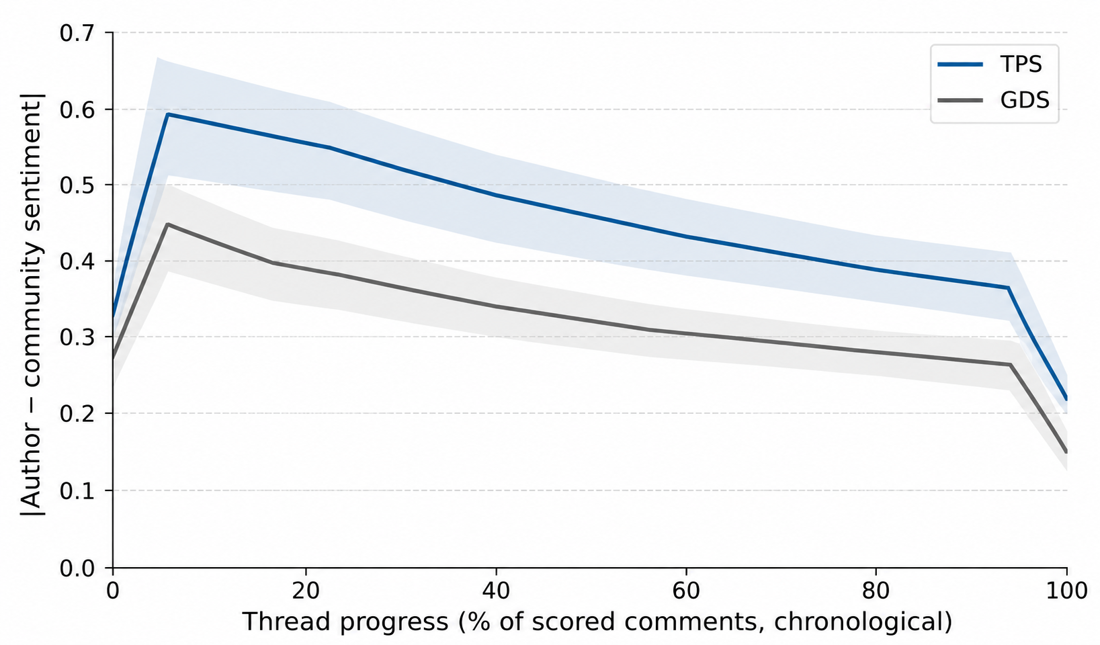
Fig. 5 of the paper
What went well
- Beats the VADER baseline
- TPS threads diverge more
- 91% human agreement
Limitations
- Only 542 threads
- Few problem threads (86)
- RoBERTa did not beat NB
- The current answer pipeline cannot independently reason, plan, act
An Adaptive Multi-Agent RAG Architecture for Software Ecosystem Update Monitoring
S. D. Pujari, S. Berhe · Workshop on Agentic Software Engineering (AgenticSE '26), San Jose
Lead student author: Shradha Devendra Pujari
Rewriter: from “Did the latest versions of Zoom or Teams show any community update risks?” to “Do you recommend browser-based Zoom or Teams for my important meeting?”
Retriever: from a live risk filter to vendor-aware search
Evaluator: from a merge rule to a 0 to 1 score with retry
Orchestrator: from a source router to a team that delegates
Retrieval quality on 50 questions: one agent 0.680, four roles 0.798, +17.2% (Source: AgenticSE 2026)
Method
Data: 50 real questions, five categories
- Llama 3.1 8B, run locally
- Vendor-aware retrieval
- Score below 0.30: retry
- Memory learns expansion terms
Fig. 2 of the paper
Result
Table 1 of the paper
Method
Data: same judge and corpus, 10 to 300 questions
- Standard ruler: nDCG@3
- Bug: rewrite replaced query
- Fix: search both wordings
Bug and fix (Source: Berhe Lab, 2026)
Result
Standard metrics, n = 10 (Source: Berhe Lab, 2026)
What went well
- +17.2% retrieval quality
- No unsupported versions
- Runs locally, no cloud API
- Bug found and reported
Limitations
- Ties one agent at 0.86
- 2.3x slower than one agent
- 3+ model calls per question
- Memory gain: drifting corpus
The Paper's Idea, Shipped
releasetrain's own Ask pipeline picker
Before: Auto picked from five presets named for what changed under the hood (multi_agent_fixed, multi_agent_buggy, multi_agent_feedback...); a question like “Is there a known CVE in the latest Zoom update?” ran a one-loop pipeline with capability flags, not real delegation.
After: Two presets that match this paper directly: orchestrator_single does everything itself, orchestrator_delegated spawns a real Rewriter, Retriever, and Evaluator. Auto now routes by the question's own classified intent, so that same CVE question gets real role delegation.
Auto: 5 preset names, only cve/patch got union-search-and-rerank
Auto: 2 presets, comparison/cve/patch/general all get real delegation
One limit this shipped without fixing: a comparison question (“Which is more stable right now, Zoom or Teams?”) still bypasses both presets entirely and always runs one fixed model call, same as before, since that path was never architecture-dependent.
Vendor Matching: Substring Fallback
Retriever's own catalog lookup
Before: a compound subreddit name (r/applehelp, r/AndroidQuestions) matched itself in the vendor catalog before the real product inside it was ever considered, resolving to an unhelpful "vendor" with no tracked data.
After: a three-pass lookup: exact match against a real product first, then a guarded substring match (both sides 4+ characters, real products only) that resolves r/applehelp to apple, then exact match against any catalog entry as a last resort so a question still resolves to something.
"r/applehelp" → vendor "applehelp" (no tracked data)
"r/applehelp" → vendor "apple" (real product, has tracked data)
Disclosed limit: the 4-character minimum is deliberate, so a short subreddit name never risks a false-positive substring match.
A New Agent: Classify
Source trust + CVE patch artifacts
Before: every source read with equal weight, and a CVE citation always linked to NVD's description page, never the fix.
After: a new deterministic step, Classify, runs between Retrieve and Evaluate. It verifies each source's url and tags it official/community/unverified from real signals (vendor-domain match, known CVE databases, GitHub/Reddit/Stack Exchange), never a model guess. A CVE source also gets a verified patchUrl from NVD's own tagged references.
CVE citation: NVD description page only, no trust signal on any source
Every source: official/community/unverified + a live-checked url; a CVE also gets a verified patch link when tagged
Disclosed limits: only the delegated architecture runs Classify; a CVE scraped before this change has no patch link until it's rescraped.
Sources Tab: A Real Example
"Any known CVEs in the latest Linux update?"
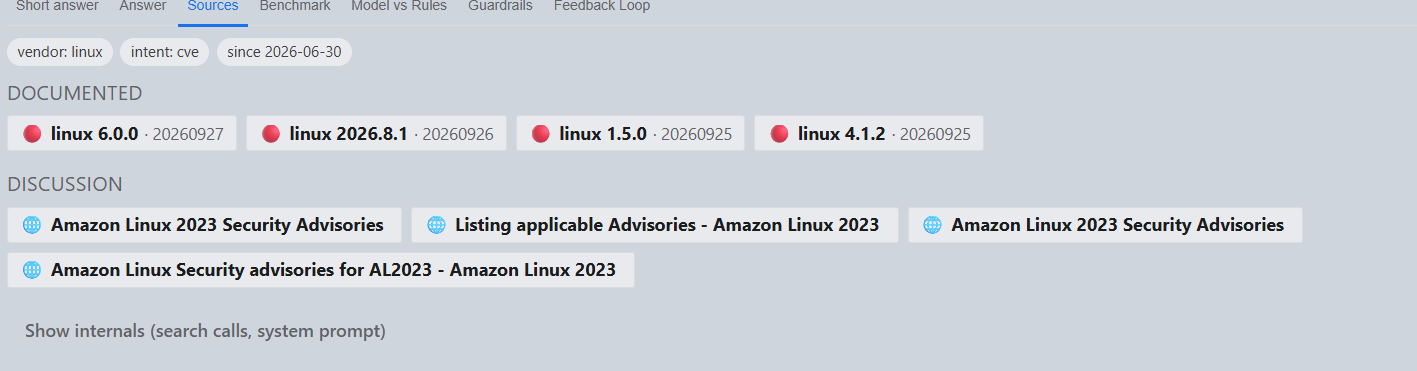
Live screenshot, releasetrain.io
Documented (red dot): this system's own tracked release/CVE data (kind === "cve" or "release").
Discussion (blue globe): community/web evidence (Reddit, Stack Overflow, a live web search) the model also drew on.
Not shown yet: Classify's own trustTier/urlVerified (previous slide) already ride along in the API response for every source above, but this view doesn't badge them visually yet, by design (scoped to API-only for now, before adding UI for it).
A New Guardrail: artifactRetry
"I want artifacts and if there are none say so"
Before: a version/CVE source's own url was treated as "no artifact" unless it already contained a literal /commit/ or /archive/ segment: a perfectly real github.com repo link, or a vendor's own Teams/Chrome installer page, was called a "generic reference page."
After: hasRealArtifact recognizes a bare GitHub repo (it always has a Download ZIP), a direct installer file (.exe/.dmg/.pkg/.msi/.apk), or an app-store listing as real by shape. When nothing qualifies, a new guardrail runs one guaranteed, code-driven search_web call for the vendor's official download/install page or app-store listing before giving up, not just a prompt hint the model can ignore.
"Latest Teams version?" → "no artifact found," even after a live search
Guaranteed search finds statics.teams.cdn.office.net's real MSTeamsSetup.exe (verified 200 OK)
Disclosed limit: verified live, a small/free-tier model often won't spend an extra tool call searching for this on its own, which is exactly why this is a deterministic fallback, not only a system-prompt suggestion.
Feedback Loop: Check Both App Stores
"have a feedback loop... to also look ios or android app store"
Before: the guaranteed search above ran once; a real app is often published on both mobile stores, but one plain web search tends to only rank one of them.
After: when the search lands on one store's listing (Google Play or the Apple App Store) but not the other, it runs one more targeted search for the missing platform, and the query itself now says "download or install," not just "download."
"Latest Chrome version?" → only whichever store search happened to rank first, or neither
Both apps.apple.com and play.google.com listings, verified live on a clean search run
Disclosed limit: verified live, moments apart: this system has no paid search API, so DuckDuckGo/Bing scraping can silently degrade to generic top results with no error. The same run that found both stores once returned only generic pages on the next three tries, after DuckDuckGo rate-limited the test IP.